
What is a Roaming Fee?
A roaming fee is an additional cost applied when an electric vehicle (EV) driver charges at a public charging station using a pass or app issued by an chargecard provider (external eMobility Service Provider, eMSP), rather than the one operating the charging station. This fee covers the technical and financial requirements for interoperability and data exchange between different eMobility platforms, ensuring a seamless charging experience across multiple networks.
Who Pays the Roaming Fee?
The owner of the charging pass pays the roaming fee. It is typically included in the total price per kilowatt-hour (kWh) displayed in the chargecard supplier's (eMSP) application or invoice. The fee guarantees drivers can access a wide network of public charging stations—even those outside their home provider.
When you charge using your employer's charging card, in general the employer pays for this roaming fee.
How is the Roaming Fee Calculated?
The total price an EV driver pays incorporates several components:
- Base Tariff: Set by the owner of the charging station through the Charging Point Operator (CPO) for energy (€/kWh), parking (€/min), or session (€/session). The owner of the charging station receives this payment.
- Roaming fee Surcharge: Added by the roaming platform or CPO to cover operational, infrastructure, and data exchange costs.
- Chargecard supplier (eMSP) Margin: A markup added by the eMSP to offset their own transaction costs and profit margin. This is unknown Maxem and varies per eMSP. It is also possible that the card supplier bills a subscription instead of a markup.
Example Calculation
| Base Tariff | €0.40/kWh |
| Roaming fee Surcharge | €0.04/kWh |
| eMSP Markup | €0.10/kWh |
| Total Price | €0.50/kWh |
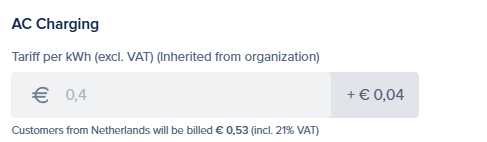
This looks as followed in the Maxem Energy Cloud:
Backend Process Flow
- The EV driver starts a charging session using their roaming-enabled pass or app.
- The charging transaction is recorded as a Charge Detail Record (CDR) and sent to the eMSP (chargecard provider).
- The roaming fee is automatically added to the base tariff during processing.
- The eMSP invoices the driver for the total amount (including their own surcharge).
- The eMSP pays the total transaction cost to Maxem
- Maxem settles directly with the location owner for the base amount
Where Can Roaming Fees Be Viewed?
- Maxem Energy Cloud: Roaming transactions are clearly labeled and can be filtered for reporting.
- Monthly Transaction Records: Roaming fees are itemized per charging session.
- On the reimbursement invoice.
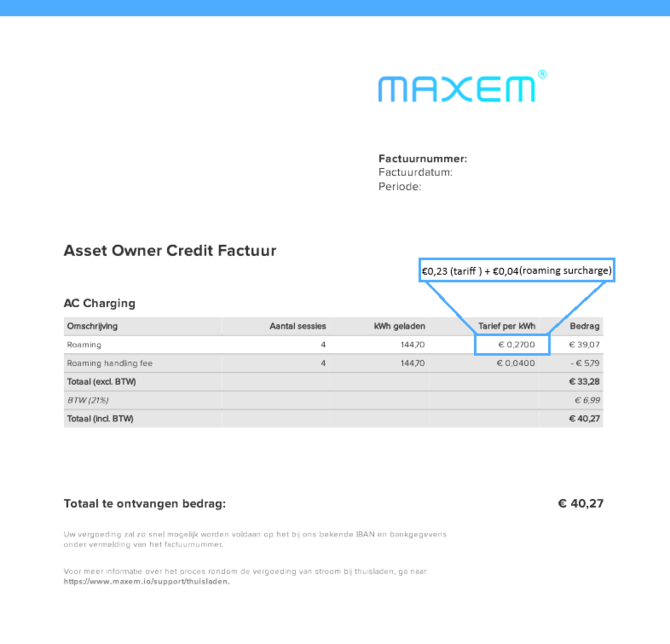
How do I read this on the reimbursement invoice?
You receive the reimbursement invoice monthly at the end of the month. You can also find them by logging into the platform and clicking on 'invoices' on the left.
Next, you will see the sum of the tariff you have set and the roaming surcharge on the invoice. This is the amount that the charging card issuer invoices to the cardholder.
After this, the roaming surcharge is deducted from this to arrive at the reimbursement tariff. The reimbursement tariff is equal to the tariff you have set in the platform.
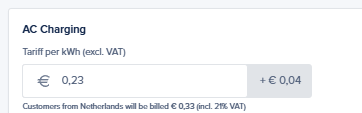
This looks as follows in the tariff settings in the platform:
FAQ
Why do I pay less or more then the total price (tariff) as is set in the Maxem Energy Cloud?
Some chargecard providers ignore the set price and charges a fixed tariff per kWh. For example Shell Recharge has a fixed price per kWh, which can cause you to pay a different price.
If I only use whitelisted passes do I have to pay any of these costs?
No, if you correctly added the passes to the whitelist and setup the access mode correctly then you don't pay any of the mentioned costs. Whitelisted cards charge for free.
Do I receive the VAT back in my reimbursements?
Yes, you receive the VAT back in the reimbursements. The VAT is collected by the charging card provider and paid out to the charging station owner.